Don't Treat AI's Skillset as Static
or: The Future Will Be Weirder Than That, Part II
People often treat AI as if it will improve on its current capabilities, but won’t gain any new ones. Supposedly, AI will continue to get better at coding and at assisting with research, but it won’t broadly replace human labor. It won’t be able to do good strategic planning, and certainly won’t know how to operate in the physical realm.
Maybe that’s true. But we don’t have strong reason to believe it. Just looking at the past few years, AI has rapidly acquired new skills. The simplest extrapolation of recent trends is that it will continue to do so.
Some people think of AI capabilities growth like this, with each colored area representing another few years of progress:1
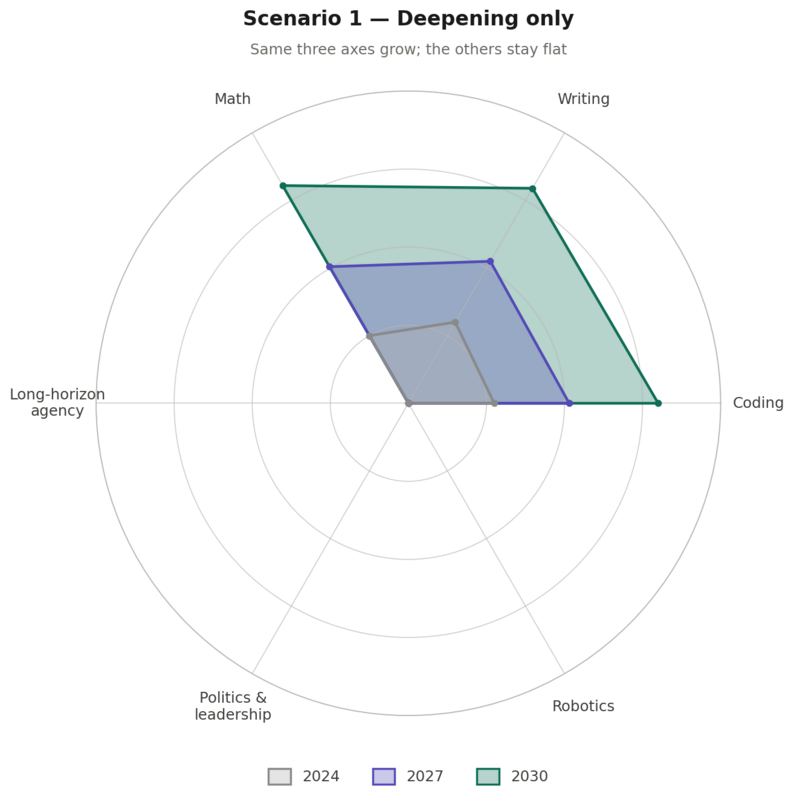
But it’s more likely to look like this:
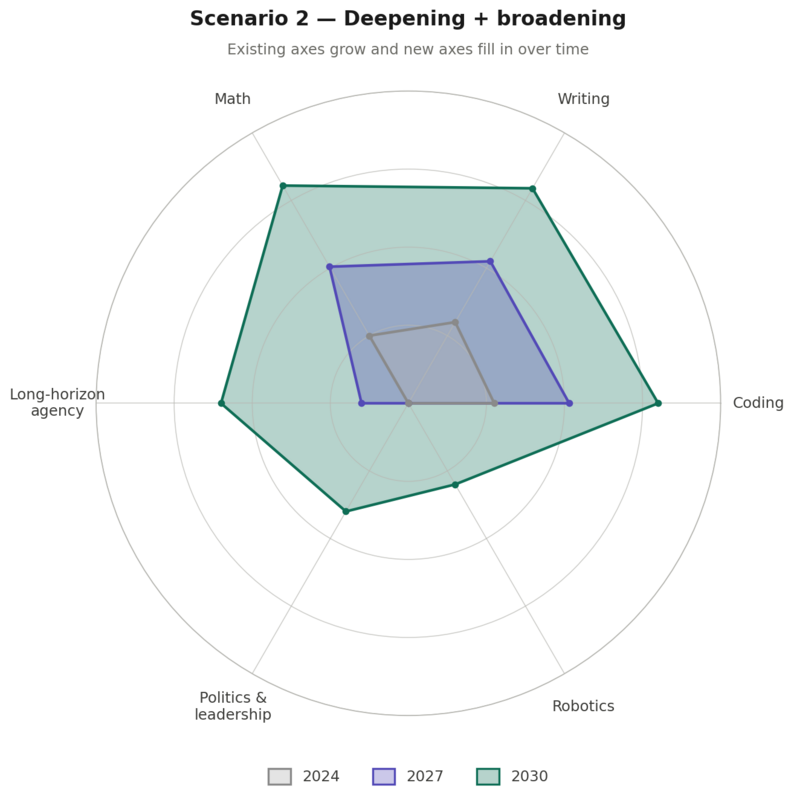
If you look at most impressive capabilities of today’s smartest AI systems, they cover domains where AI was basically useless five years ago. AI wasn’t capable of writing functional code until 2021, and even then, it was limited to short snippets and required human oversight to catch errors. It’s only been able to autonomously write code since 2025.
In 2021, AI couldn’t reliably do arithmetic. A year ago, it was good enough to help you with your math homework, but it couldn’t do original research. Fast forward to today, and AI is answering century-old conjectures on a weekly basis.2
If I assume AI will only improve at the things it’s already good at—if it’ll be superhuman at coding and math, but won’t improve otherwise—then I’m taking a myopic view on AI development. It gained all these new capabilities in just a few years; presumably it will continue to gain more capabilities! If I assert that AI will keep improving without gaining new skills, then I’m making a strong prediction that is not consistent with recent history.
Sometimes people say, well, AI is highly unpredictable, so I’ll just naively extrapolate from history. The problem is, a lot of people extrapolate wrong. A correct extrapolation says AI will soon learn to do the things it’s currently bad at.
I’m bearish on projects that could be described like this:
Our long-term goals depend on X and Y. Right now, AI is good at X. For this project, we will investigate ways to leverage AI to do X, and focus on doing Y ourselves.
I’m especially bearish when these projects would take several years to play out. Given how rapidly AI’s skills are changing, it’s likely that your method of doing X will be obsolete, and AI will have improved substantially at doing Y anyway.
Example: In 2023, there were “LLM whisperers” who knew how to talk to LLMs to elicit more powerful capabilities than most people could access. At the time, some people put a lot of effort into learning to become an “LLM whisperer”. Today, LLMs are smart enough that there’s little advantage to knowing the special ways to communicate with them; you just tell them what you want, and they automatically know how to do it. Skills learned by LLM whisperers became irrelevant after only a couple of years.
Some say all the software development jobs will soon be replaced by AI, and you should learn a trade instead. But how do they know the trades won’t be replaced by robots in the near future? I wouldn’t be surprised if, by 2029, robot electricians could do the job better than the best humans.
I’m not strongly predicting that AI will gain new skills, or in what order it will gain skills. Those things are hard to predict. And it’s hard to predict how AI capabilities will shape the near future. What technologies will emerge? How will the economy work? I don’t know.
On the other hand, there are some easy predictions. One of AI’s best skills today is assisting with developing even better AI. That means, unless we hit a natural wall or intentionally stop building AI, we will have AGI before long.
Another easy prediction: Anything you can do, AGI can do better. Therefore, humans will not control the future. If we get what we want, it will because the AIs give it to us.